
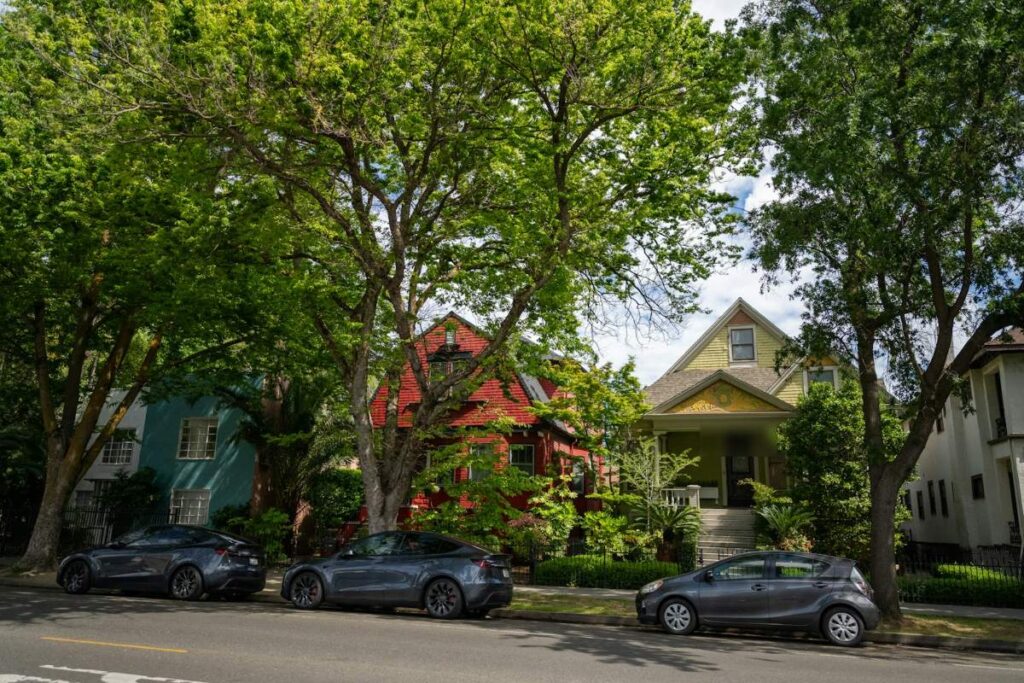
Sacramento handles street sweeping more gently than most big California cities. Crews sweep every public street with a curb and gutter once a month from February through October, but on most blocks nothing forces you to move your car. The exception is the central city: in parts of Downtown and Midtown, posted “City Services” signs ban parking on set days, and that’s where the tickets happen. Right now it’s leaf season, so sweeping is on pause until February 2027. Here’s how the whole system works.
Sacramento at a glance
- Parking fine
- $60 for parking during posted restricted hours, plus a $12.50 state surcharge
- Season
- February through October; leaf collection November through January
- How often
- Once a month on each street
- Must you move?
- Only where signs restrict parking, mainly Downtown and Midtown
- Look up your day
- Sacramento street sweeping (collection calendar and SacRecycle app)
How sweeping works in Sacramento
Street sweeping in Sacramento is run by the City’s Recycling and Solid Waste Division, the same team that collects your garbage and organics. According to the City, every street that is public right-of-way and has a curb and gutter is swept once a month, February through October. That covers both residential and commercial streets.
Two kinds of streets are left out. Private streets aren’t swept by the City, and the City notes that most developments built in the last 20 years or so have private streets. Streets without curbs and gutters aren’t part of the program either.
The sweepers are built to pick up loose dirt and fine particles so they don’t wash into storm drains. They aren’t designed for large litter or debris, so a sweep won’t clear a pile of branches or junk left in the gutter.
Sweeping is paid for through your utility bill. The City spreads the cost of nine months of sweeping across twelve monthly charges on the combined water, waste and sewer bill, which is why you see a charge even in winter.
Do you have to move your car?
This is the part that surprises people who move from Los Angeles or San Francisco. The City’s own answer is that streets should ideally be cleared on sweeping days, but there’s no requirement to move your car for sweeping unless there are signed parking restrictions.
Those signed restrictions are concentrated in parts of Downtown and Midtown, where the City posts “City Services” parking restrictions so sweepers, garbage trucks and leaf crews can reach the curb. The City describes two types:
| Type of restriction | Where it applies | What happens on that block |
|---|---|---|
| Weekly restrictions | Blocks where homes get weekly garbage and organics pickup | Waste collection access each week, street sweeping in the first week of the month, leaf service in leaf season |
| Monthly restrictions | Blocks without weekly City residential waste service | Street sweeping in the first week of the month and leaf collection in leaf season |
The exact day and hours are printed on the signs on each block, so the sign is what counts. The City notes that drivers with disabled person (DP or DV) placards must also follow posted restrictions for City services; a placard doesn’t let you park there during the posted times.
Here’s how people get caught. Imagine Priya, who just moved into a Midtown apartment from a suburb where nobody ever moved their car for the sweeper. She parks on her new block on a Sunday night, doesn’t read the sign at the corner, and finds a ticket on Monday morning because the first Monday of the month is her block’s City Services day. Outside the central city she’d have been fine; on that block, the sign was all that mattered. Our guide to reading street sweeping signs explains how to decode signs like these.
When your street will be swept
Each street gets one sweep a month during the season. The easiest way to see your dates is the City’s collection calendar or the free SacRecycle app: enter your address and you’ll see street sweeping alongside your garbage, recycling and organics days.
- Reminders: you can sign up for an optional reminder the day before sweeping, which is handy if you park on the street even where there’s no sign.
- New calendar each year: the City says February through October dates are usually posted by January 15. If you look in November, December or January, you won’t see sweeping dates at all.
- Duplexes and small buildings: if no dates show up, try another address at your building. Only one address in a duplex, triplex or fourplex is the billing address in the calendar.
- Missed sweep: if the calendar said your street was due and it wasn’t swept, the City asks you to email sacrecycle@cityofsacramento.org with your full street address and the dates.
For more ways to never miss a sweeping day, see our guide to street sweeping alerts and reminders.
Leaf season and the claw
From November through January, Sacramento swaps street sweeping for leaf collection. In the “City of Trees” that’s a big deal: residents can put extra yard waste in loose piles in the street, and a tractor with a grabbing arm, known locally as the claw, comes by several times during the season to scoop them up. The City says leaf season collection for 2026-27 began on November 2, 2026.
Leaf piles affect parking, so it helps to know the City’s rules for them:
- Piles should be no more than five cubic yards (about 4 by 4 by 9 feet).
- Piles should sit 6 feet from any obstruction, and the City lists cars as an example. If you park right next to a pile, the claw may not be able to reach it.
- Leave space between the curb and the pile so water can reach storm drains, and keep piles out of bike lanes where possible.
- Fill your organics container first. The City says that when people use their containers along with piles, streets get cleaner faster and more parking is available.
The claw doesn’t follow a fixed weekly schedule. Visits can be closer together early in the season and further apart when leaf volume, storms or equipment slow crews down. The collection calendar and SacRecycle app show an estimate of the next pickup. Our guide to fall leaves and street sweeping explains how other cities handle the same problem.
What a ticket costs
Sacramento’s fine list doesn’t have a line called “street sweeping.” A ticket on a City Services block is a parking violation against the posted sign. On the City’s current list of fines, parking during posted restricted hours (“No Parking Certain Hours,” Sacramento City Code 10.36.040) is $60. The City says its posted fine schedules are for reference only and don’t override the amount printed on your citation.
| Item | Amount |
|---|---|
| Parking during posted restricted hours | $60 |
| State surcharge on every parking citation | $12.50, which can’t be waived |
| Not paid or contested within 21 days | The fine doubles and you get a new due date |
| Still unpaid after the new due date | An extra $15 penalty, and the citation can go to a collection agency |
Unpaid citations also follow your car. The City says unpaid parking citations affect the registered owner’s vehicle registration through the DMV, and the hold stays until the citations are paid or you show proof of a payment plan. Residents also need all citations paid to get a residential virtual vehicle permit. Our guide to what happens if you don’t pay a parking ticket explains the DMV side in more detail.
Two other Sacramento rules are worth knowing while you’re parked on the street. The City can remove a vehicle left on a street for 72 hours or more (see our 72-hour parking rule guide), and California’s daylighting law limits parking near crosswalks.
Paying or contesting the ticket
You have 21 calendar days from the issue date on the citation to pay, set up a payment plan or contest it. City of Sacramento citations are handled through the City’s Citation Services; the City’s resident guide points drivers to SacPark.org to pay or contest.
Payment plans. Both the City and the County offer zero-interest monthly payment plans for drivers who need help with citation balances, and the City’s fine page mentions plans for balances of $100 or more. Staying current on a plan lets you renew your registration. See our guide to parking ticket payment plans.
Contesting. You don’t have to pay first or go to court. You can contest online, by mail or email, or in person with the contest form; the City says it won’t accept verbal contests over the phone or at the counter. Include your name, address, phone, citation number, date, location, violation code and license plate, plus your reason and any evidence. Don’t send payment with a contest, because fees are frozen while it’s under review.
- Contests are reviewed by Citation Contest Officers who are independent from the officers who write tickets.
- A decision can take about 90 days to six months and is mailed to the registered owner.
- If you’re found not liable, the citation is dismissed. If you’re found liable, you can pay the original amount or request an Administrative Hearing, which requires a deposit.
On a City Services block, the strongest evidence is usually about the sign: photos showing it was missing, faded, hidden by a tree or contradicted by another sign. For more ideas, see evidence that wins a street sweeping appeal.
Official contacts and links
| What you need | Where to go |
|---|---|
| Sweeping schedule, reminders and FAQs | Sacramento street sweeping; collection calendar and SacRecycle app |
| Leaf season and the claw | Sacramento leaf season |
| Missed sweep | sacrecycle@cityofsacramento.org |
| Fine amounts | Sacramento citation fines |
| Pay, contest or set up a payment plan | Sacramento Parking Enforcement and SacPark.org |
| Everything else | Sacramento 311 |
Other city guides
- Oakland street sweeping
- Berkeley street sweeping
- San Francisco street sweeping
- San Jose street sweeping
- All 19 cities
Spotted something out of date? Report an error and we will check it against the official source. Missing a city? Request it here.
Last checked against official City of Sacramento sources (Recycling and Solid Waste Division, Parking Services and Citation Services) and the Sacramento City Code: November 2026.