
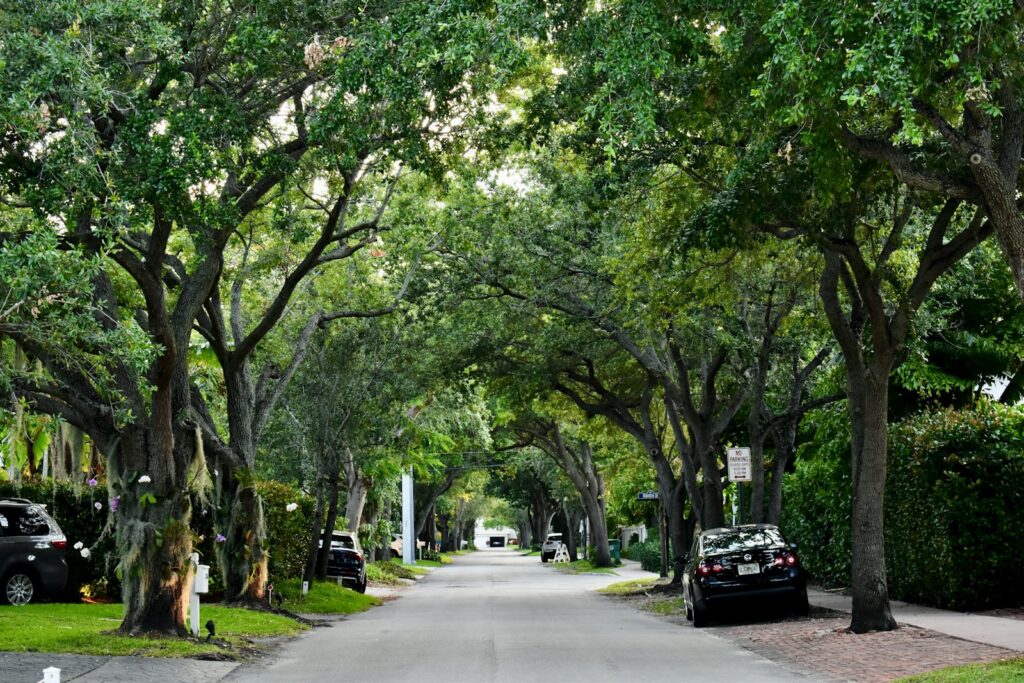
The street is narrow, cars are parked on both sides, and a delivery truck is trying to get through. So you do what half the block does: pull two wheels up onto the sidewalk, or onto the strip of grass between the sidewalk and the curb, to “leave room.” It feels considerate. In every city in this guide it’s a ticket, from $35 in Denver to $115 in New York, and on sweeping day it’s an easy one for an officer to spot. Here is what counts as the sidewalk, what counts as the parkway or planting strip, and what each city charges.
Sidewalk and parkway parking at a glance
- Sidewalk
- No part of the car may be on it, not even two wheels or a bumper
- Parkway or planting strip
- The grass or dirt strip between sidewalk and curb; no parking in LA, Chicago and Seattle
- Lowest ticket
- $35 in Denver
- Highest ticket
- $115 in New York, $108 in San Francisco
- Common excuse that doesn’t work
- “I was leaving room for traffic”
Fines city by city
| City | Sidewalk | Parkway or planting strip | Source |
|---|---|---|---|
| New York City | $115 (code 51) | Not listed separately | NYC Finance |
| San Francisco | $108 | Not listed separately | SFMTA fine table |
| Berkeley | $89 | Not listed separately | Berkeley fines |
| Seattle | $69 | Not allowed | SDOT, court fines |
| Boston | $65 | Not listed separately | Boston Parking Clerk |
| Chicago | $60 | $60 | Chicago Finance |
| Los Angeles | Not allowed (state law) | Not allowed since 2017 enforcement | LADOT |
| Denver | $35 | Not listed separately | Denver ordinances, fines |
In California the rule starts at state level: Vehicle Code 22500(f) bans parking on any portion of a sidewalk, or with the body of the car extending over it. Each city then sets the fine, which is why the same mistake costs $108 in San Francisco and $89 in Berkeley.
What counts as the sidewalk
“Any portion” is meant literally. Two wheels on the curb count. A bumper hanging over the sidewalk line counts. SFMTA says you can be cited even if pedestrians can still get past, so “there was plenty of room” is not a defense.
The reason cities are strict about it is accessibility: a car that leaves three feet of sidewalk for a walker can still block a wheelchair, a stroller or someone with a cane. It’s also one of the easiest tickets for an officer to write, because there’s nothing to measure.
The parkway or planting strip
Many residential streets have a strip of grass, dirt or gravel between the sidewalk and the curb. Cities call it different things: the parkway in Los Angeles and Chicago, the planting strip in Seattle. It looks like private yard, but it’s public right of way, and in these cities you can’t park on it:
- Los Angeles: LADOT defines the parkway as the area between the sidewalk and the curb that is not intended for vehicles, and began enforcing the ban, section 80.53 of the municipal code, on August 14, 2017.
- Chicago: parking or standing on a parkway is its own violation, $60, the same as the sidewalk.
- Seattle: SDOT’s rule is simple: don’t park on sidewalks or the planting strip between the sidewalk and the street.
- Denver: the ordinance bans parking on a sidewalk or a “sidewalk area”, so treat the strip as off limits unless a sign says otherwise.
A realistic example: a family in a Chicago bungalow neighborhood has three cars and one garage. On the night before sweeping, the street is full, so one car goes up onto the grass parkway in front of the house. In the morning it has a $60 ticket, and the sweeper still couldn’t reach that stretch of curb.
The driveway overhang
The most common sidewalk ticket isn’t on the street at all. It’s a car parked in its own driveway that is longer than the driveway, so the back end sits over the sidewalk. Parking in your driveway is generally fine; letting it stick out is not. Our guide to parking in front of a driveway covers that case, including how San Francisco lets some owners park across their own curb cut instead.
On a steep block it’s even more tempting to tuck the car in at an angle. If you do, turn the wheels the right way and keep the bumper off the sidewalk; see our guide to parking on a hill.
Narrow streets and sweeping day
The night before sweeping, every car on one side of the block has to fit on the other side. On narrow streets that’s when people start putting two wheels on the curb. Three better options:
- Park around the corner on a street with a different sweeping day, even if it means a short walk.
- Use the driveway properly: fully inside, with nothing over the sidewalk.
- Check the corner rules before you squeeze into the last gap; in California the 20 feet before a crosswalk is off limits under the daylighting law, and the space around a hydrant has its own rule, explained in our fire hydrant guide.
If you got a sidewalk ticket
Sidewalk tickets are hard to fight, because the rule covers any part of the car. The arguments that can work are about facts: the area was not a sidewalk (for example, a private paved area with no public walkway), or the ticket has the wrong plate, location or time. Take photos from both sides before you move the car.
Our guide to appealing a ticket explains the deadlines in each city, and the fines by city page compares sweeping tickets.
Spotted something out of date? Report an error and we will check it against the official source. Missing a city? Request it here.
Last checked against the California Vehicle Code and official sources from New York City, San Francisco, Berkeley, Seattle, Boston, Chicago, Los Angeles and Denver: November 2026.