
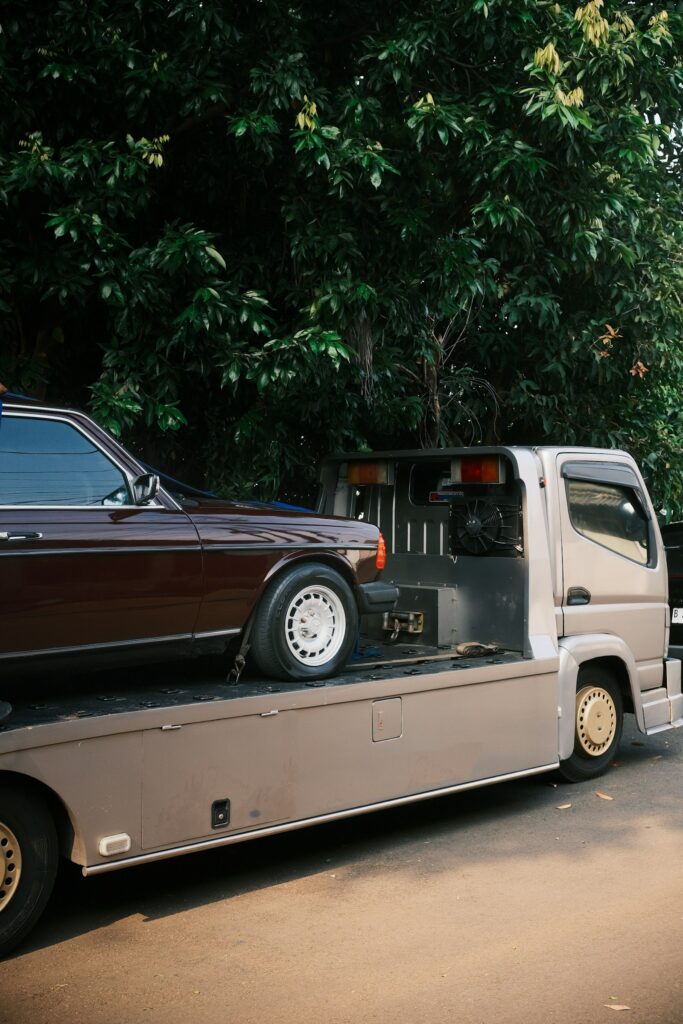
At 2:40 on a weekday afternoon in San Francisco’s SoMa, you find a free spot at a meter, pay for two hours in the app, and head into a meeting. When you come back at 4:30, the spot is empty. The meter took your money, but the red and white sign on the pole said “Tow Away, No Stopping, 3 PM to 7 PM.” That one mistake can cost around $760 before storage. Commute-hour tow-away zones are the parking rule most likely to make your car disappear. Here is how they work in San Francisco, Los Angeles, Chicago and Boston, and how they overlap with street sweeping.
Tow-away zones at a glance
- What they are
- Parking lanes that become traffic lanes during rush hour
- Typical hours
- Weekday mornings and afternoons; the exact times are on the sign
- Exceptions
- None for disabled placards, residential permits or paid meters in San Francisco
- Parking fine
- $90 in Boston, $100 in Chicago, $108 in San Francisco
- Cost of a tow
- In San Francisco, $652 in tow and administrative fees for a first tow, plus storage
The rule city by city
| City | What the sign says | When | Parking fine | Source |
|---|---|---|---|---|
| San Francisco | Tow Away, No Stopping | Usually 7–9 a.m. and 3–7 p.m. | $108, plus the tow | SFMTA, fine table |
| Los Angeles | Anti-Gridlock Zone, red sign at the top of the pole | Posted hours between 6 a.m. and 7 p.m. | Set by LADOT; can include a tow | LA Municipal Code 80.70 |
| Chicago | Rush hour parking restriction, often marked as a tow zone | Posted hours | $100 | Chicago Finance |
| Boston | No Stopping or No Standing during rush hour | Posted on the meter and signs | $90 | Boston tips, fines |
The idea is the same everywhere: on busy streets, the curb lane is for parking most of the day and becomes a travel lane during the commute. In Los Angeles, the city’s ordinance lets LADOT turn the parking lane of a major street into an anti-gridlock zone during posted hours between 6 a.m. and 7 p.m. In Boston, the city notes that many metered streets downtown become an extra travel lane during rush hour. In Chicago, a vehicle parked illegally in an officially marked tow zone can be towed right away under the municipal code.
The meter trap
The SoMa story above is the classic way people lose their car. The meter or the app may still let you pay, but that does not override the tow-away sign. SFMTA warns about exactly this: at a meter, your time is still limited by the commute-hour restriction, however much you pay for.
Two habits fix it:
- Read every sign within 100 feet, as SFMTA recommends. The tow-away sign may be on a different pole from the meter.
- Set a phone alarm for 15 minutes before the restriction starts, not for when the meter runs out.
A tip from SFMTA that sounds obvious but isn’t: if a busy street has a suspiciously long row of empty spaces in the afternoon, look up. There is usually a tow-away sign.
No placard, no permit, no “I was in the car”
In San Francisco, commute-hour tow-away restrictions take priority over every other sign on the street, and there are no exemptions for disabled placards or for stopping to pick someone up or drop them off. Stopping at all is a citable violation, even if you stay in the car. The same logic applies to residential permits: as our guide to residential permits and street sweeping explains, a permit only covers the time limit on your block.
Boston’s signs come in two kinds, and the difference matters. In a “No Stopping” zone, you cannot park or even stop to drop someone off or load the car. In a “No Standing” zone, you cannot park, but you can drop off, pick up or load.
When the sweeping sign says tow-away
Some street sweeping signs carry their own tow warning. In Boston, cars parked against daytime street cleaning signs can be towed, as our Boston guide explains. In Denver, the fine schedule lists street sweeping under “Tow Away Zone” at $50, and cars can be ticketed and moved, as our Denver guide covers. In Chicago, orange street cleaning signs can designate the block as a tow zone.
When you read a sweeping sign, look for the words “tow-away” or a tow truck symbol. If they are there, the cost of forgetting is not a $40 or $60 ticket; it is the ticket plus the tow and storage. Our guide on reading sweeping signs shows where that wording usually appears, and the guide to temporary no parking signs covers the paper signs that also lead to tows.
What a tow really costs
San Francisco publishes its fees in detail, so it makes a good example. For a standard car, a first tow in San Francisco adds up like this:
| Item | Amount |
|---|---|
| Tow-away zone ticket | $108 |
| Administrative fee, first tow | $335 ($385 for repeat tows) |
| Tow fee | $317 |
| Storage | Free for the first 4 hours, then $69 for the first day and $82 for each day after |
| Total if picked up within 4 hours | $760 |
Leave the car at the impound over a weekend and storage alone adds more than $200. SFMTA offers reduced fees for low-income drivers and waivers for people experiencing homelessness; see the towed vehicles page for details.
If your car was towed
- Confirm it was towed, not stolen. In San Francisco, call the City Impound at 415-865-8200. In Chicago, the city’s towing page explains how to find your car at the auto pound.
- Go quickly. Storage fees grow every day the car stays there.
- Bring ID and payment. San Francisco requires you to appear in person and pay all fees before the car is released.
- Photograph the signs on the block if you plan to contest. A missing, hidden or contradictory sign is the strongest argument.
Our guide to appealing a ticket explains the deadlines, and the fines by city page compares sweeping tickets across the cities we cover.
Towed in another city? See how to find a towed car and get it back in Boston, Chicago, New York and Los Angeles.
Spotted something out of date? Report an error and we will check it against the official source. Missing a city? Request it here.
Last checked against official sources from San Francisco (SFMTA), Los Angeles, Chicago and Boston: November 2026.