
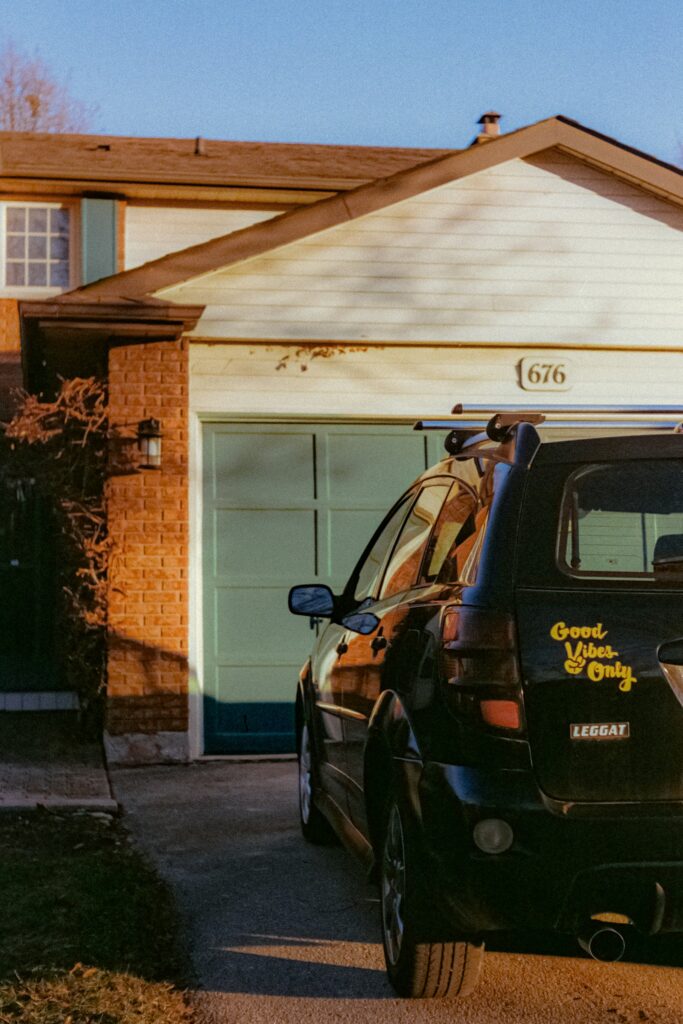
A guest arrives on a Saturday, finds no space on the block, and leaves their car across the end of your driveway “just for an hour.” Or it is your own car, parked across your own curb cut because the street is full and, after all, it is your driveway. In most US cities both are ticketable. The surprise is that a few cities do let you block your own driveway, under conditions that are easy to miss. Here is how the rule works in California, San Francisco, New York City, Chicago, Seattle and Denver.
Driveway parking at a glance
- Someone else’s driveway
- Never, in every city in this guide
- Your own driveway
- Allowed in San Francisco and New York City with conditions; in the rest of California only where the city has a permit ordinance
- Extra buffer
- 5 feet on each side of the driveway in Seattle and Denver
- Parking fine
- $35 in Denver, $69 in Seattle, $95 in New York, $150 in Chicago
- Parking in the driveway
- Generally fine, as long as no part of the car sticks out over the sidewalk
The rule city by city
| City | In front of a driveway | Your own driveway | Parking fine | Source |
|---|---|---|---|---|
| California (state law) | Not allowed | Only if the city issues permits for it | Set by each city | Vehicle Code 22500, 22507.2 |
| San Francisco | Not allowed | Allowed with five conditions | Set by SFMTA | SFMTA driveway guide |
| New York City | Not allowed | Allowed for owners of one- and two-family lots | $95 (code 98) | NYC Finance, Admin Code 19-162 |
| Chicago | Not allowed if it blocks access | No owner exception in the rule | $150, plus a $100 late penalty | Chicago Finance |
| Seattle | Not allowed, nor within 5 feet | No owner exception in the rule | $69 | SDOT, court fines |
| Denver | Not allowed, nor within 5 feet | No owner exception in the rule | $35 | Denver ordinances, fine schedule |
Chicago’s rule, section 9-64-100(c) of the municipal code, is worded around access: you cannot park where your car blocks vehicle access to a driveway or an alley. There is no set distance, so a car that leaves the opening clear is not covered, and one that pinches it half closed can be.
Blocking your own driveway: where it is allowed
California’s Vehicle Code bans parking in front of any public or private driveway, and that includes yours. But section 22507.2 lets a city pass an ordinance allowing owners and tenants to park across their own driveway with a permit. So in California the answer depends on your city: if it has no such ordinance, the state ban applies to you like anyone else.
San Francisco is the best-known exception. According to SFMTA’s guide, you can park parallel to your own curb cut if all five of these are true:
- the building has one or two units;
- the car’s license plate is registered to that address;
- the car does not block a pedestrian walkway;
- you follow the other parking rules on the block, such as street cleaning;
- the driveway is not inside the 20-foot daylighting zone before a crosswalk.
The condition people trip on is the registration. Picture someone who moves from an apartment in Oakland into a duplex in the Sunset, parks across their new curb cut every night, and has not yet updated the address on the car’s registration. To the parking officer, that is a stranger’s car blocking a driveway.
New York City has a similar rule in section 19-162 of the Administrative Code: the owner or lessor of the lot can park a passenger car registered to them at that address in front of the driveway, as long as the lot has no more than two dwelling units. If you get a ticket anyway, the hearing officer must dismiss it when you show a registration that matches the address. Keep a copy of the registration handy; it is your whole defense.
The 5-foot buffer in Seattle and Denver
In Seattle and Denver, the no-parking zone is wider than the driveway itself. Denver’s rule, section 54-458(2), bans parking in front of an alley or driveway or within 5 feet of it. Seattle measures the 5 feet from the end of the sloped curb (the driveway return) on each side, as SDOT’s driveway markings page shows.
In practice: if your neighbor’s bumper is three feet from the edge of your driveway in Seattle, they can be ticketed even though you can still squeeze out. Five feet is roughly the length of an adult bicycle. Seattle also lets the property owner paint that 5-foot stretch with traffic yellow paint, which makes the rule visible to drivers who don’t know it.
Don’t try the same thing in New York City. There, according to 311, a curb painted to discourage parking in front of a driveway can be reported, and if the Department of Transportation confirms it, the owner gets a notice of defacement and has to remove the paint.
Parking in your driveway: the sidewalk trap
Parking inside your own driveway is generally fine. The street ticket comes when the car is longer than the driveway. A short city driveway, a pickup truck, and the tailgate ends up a foot over the sidewalk: that is a sidewalk violation, not a driveway one.
SFMTA is blunt about it: no part of the vehicle should extend onto the sidewalk, and you can be cited even if pedestrians can still get past. In New York the same mistake is violation code 51, $115, more than the driveway ticket itself. In Denver, parking on a sidewalk or sidewalk area is $35.
A quick check before you walk away: stand on the sidewalk and look along the line where the driveway meets it. If the bumper or a trailer hitch crosses that line, pull forward or park on the street.
Sweeping day: the curb cut is not a free space
Even where you may block your own driveway, the street cleaning sign still applies to that piece of curb. SFMTA lists it as one of the five conditions. If the sign on your block says Tuesday 8 to 10 a.m., a car across your curb cut at 8:30 gets the same street cleaning ticket as every other car on that side. Our San Francisco guide covers the schedules and the fines.
The reverse also happens: on sweeping day, the empty strip in front of a neighbor’s driveway looks like the only space left. It is not. The same goes for the gap around a fire hydrant, which has its own rules in our guide to parking near a fire hydrant. Our page on curb colors covers the painted curbs you will find nearby.
Someone is blocking your driveway
- Take a photo first, showing the car, the plate and the driveway.
- New York City: report it to 311 as a blocked driveway, with the car’s color, make, model and plate. If the car is parked inside your actual driveway on private property, 311 says to call 911, because that counts as trespassing.
- Seattle: SDOT says to call the Seattle Police non-emergency line, (206) 625-5011, for a parking enforcement officer.
- Other cities: call the city’s parking enforcement or non-emergency number. Don’t block the car in or try to move it yourself.
If you are the one who got the ticket, the strongest arguments are about facts: a photo showing the driveway opening was clear, or, in New York and San Francisco, proof that the car is registered to the address. Our guide to appealing a ticket explains the deadlines, and the fines by city page compares sweeping tickets.
On a steep block, curbing your wheels is a separate rule; see parking on a hill.
For the fines when a car sticks out over the sidewalk, see parking on the sidewalk or parkway.
Looking for somewhere to put the car on sweeping day? See where to park on street sweeping day.
Spotted something out of date? Report an error and we will check it against the official source. Missing a city? Request it here.
Last checked against the California Vehicle Code and official sources from San Francisco (SFMTA), New York City, Chicago, Seattle and Denver: November 2026.