
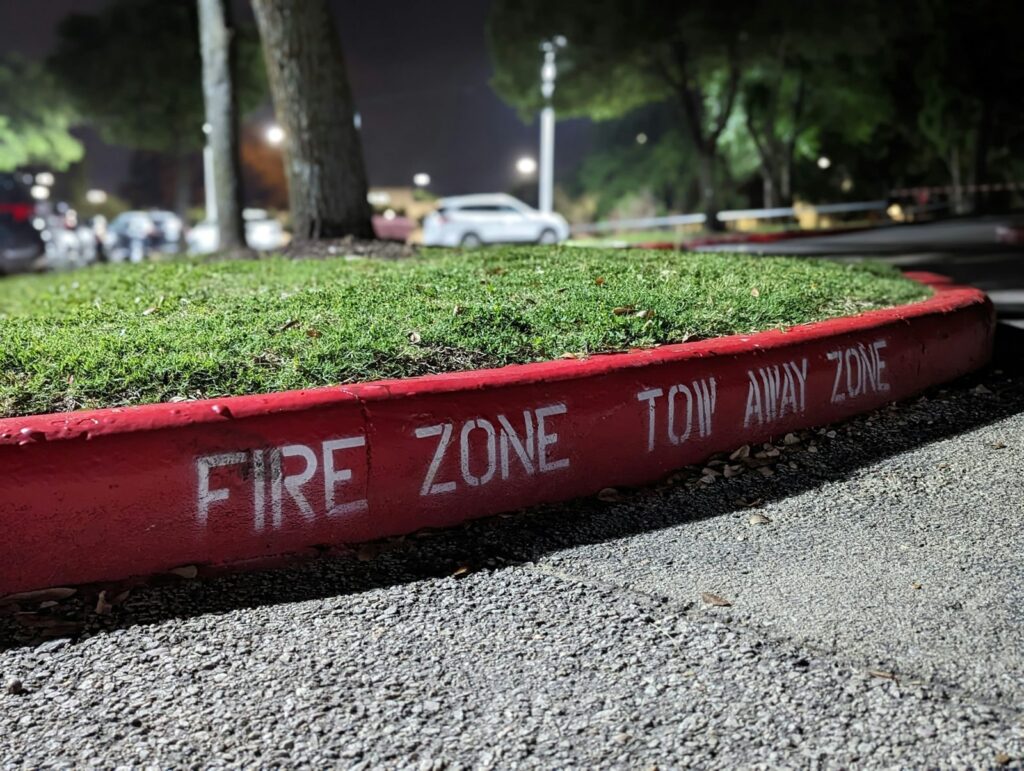
A painted curb is a parking sign without words, and in California it carries the force of state law. Red, white, yellow, green and blue each mean something specific, but the hours and minutes behind them are set city by city, which is why the same yellow curb can be fine to park at in Oakland on a Sunday and a ticket in Los Angeles on a Saturday. Here is what each color means, how Los Angeles, San Francisco and Oakland apply them, and how curb colors fit together with street sweeping signs.
Curb colors at a glance (California)
- Red
- No stopping, standing or parking, even with someone in the car
- Yellow
- Loading and unloading only, usually during business hours
- White
- Passenger loading for a few minutes, or dropping mail in a mailbox
- Green
- Short-term parking, with the limit set by each city
- Blue
- Only vehicles with a valid disabled placard or plate
What California law says
The colors come from California Vehicle Code section 21458. It defines the five colors in one line each: red is no stopping, standing or parking, attended or not; yellow is stopping only to load or unload passengers or freight; white is stopping to load or unload passengers, or to drop mail in an adjacent mailbox; green is time-limited parking; and blue is parking only for vehicles of disabled persons and disabled veterans.
What the state law does not do is set the hours. It leaves the days, hours and time limits to local ordinances. That is the reason you need to know which city you are in, and why a sign next to the curb can change the rules.
Each color, city by city
Red: never
Red means you cannot stop, stand or park, not even for a minute with the engine running. In Los Angeles, red curbs apply 24 hours a day, 7 days a week unless a sign says otherwise, and San Francisco and Oakland treat them the same way. You will find red curbs at hydrants, bus stops, corners, curb ramps and, in San Francisco, as short painted “tips” on either side of a driveway.
Yellow: commercial loading
Yellow is for loading, and mostly for businesses:
- Los Angeles: vehicles with commercial plates can stay up to 30 minutes while actively loading freight; other vehicles can load or unload passengers or baggage for up to 5 minutes. The limits apply Monday to Saturday, 7 AM to 6 PM, unless a sign says otherwise (LADOT colored curb zones).
- San Francisco: yellow zones are for commercial vehicles actively loading or unloading. Check the sign or curb stencil for the hours; a regular car can be cited, and towed if the zone is posted as a tow zone.
- Oakland: 7 AM to 6 PM, three minutes for passengers and 30 minutes for materials with commercial plates. The restriction does not apply on Sundays or parking holidays (City of Oakland parking).
White: a quick stop
White is for dropping people off, not for parking. Los Angeles allows 5 minutes for passenger loading, around the clock unless a sign says otherwise. San Francisco also allows 5 minutes during posted hours, and the driver must stay with the car, except at preschools and medical facilities. Oakland allows three minutes, generally 7 AM to 6 PM, but in front of hotels and hospitals the limit applies at all times.
Green: short-term parking
Green is the one color where you can actually leave the car, briefly. Los Angeles green zones are usually 15 or 30 minutes as posted, Monday to Saturday 8 AM to 6 PM. In San Francisco, green curbs are generally 10 minutes or less, while green meters allow 15 or 30. Oakland allows 12 minutes between 8 AM and 6 PM, with no limit on Sundays and parking holidays.
Blue: accessible parking only
Blue is reserved for vehicles displaying a valid disabled placard or plate. San Francisco enforces blue zones 24/7 and warns that parking there without a placard, or blocking access to one, means a severe fine and a possible tow. Even with a placard, a blue zone can still be covered by tow-away, special event or construction restrictions.
Los Angeles, San Francisco and Oakland compared
| Color | Los Angeles | San Francisco | Oakland |
|---|---|---|---|
| Red | Never, 24/7 | Never | Never |
| Yellow | Mon–Sat 7 AM–6 PM; 30 min commercial, 5 min passengers | Commercial loading during posted hours | 7 AM–6 PM; 30 min commercial, 3 min passengers; not Sundays or holidays |
| White | 5 min, 24/7 | 5 min, driver stays with car | 3 min, 7 AM–6 PM; always at hotels and hospitals |
| Green | 15 or 30 min, Mon–Sat 8 AM–6 PM | About 10 min; 15 or 30 at green meters | 12 min, 8 AM–6 PM; not Sundays or holidays |
| Blue | Disabled placard or plate | Disabled placard or plate, 24/7 | Disabled placard or plate |
In every case, a posted sign wins: LADOT, for example, says signs can add rules on top of any curb color and change its hours.
Curb colors and street sweeping
Curb paint and sweeping signs are separate rules, and both can apply to the same spot. Three situations come up again and again:
Green or yellow after hours
Outside their hours, green and yellow curbs become ordinary parking, and in Los Angeles LADOT says that all other parking rules apply then. That includes the street sweeping sign. A practical example: you park at a green curb in Los Angeles on Monday at 7 PM, which is fine because the green limit ended at 6. The sweeping sign on that block says “Tuesday 8 AM to 10 AM”. At 8 on Tuesday morning, both the green limit and the sweeping window start at once, so the car has to be gone by 8, not by 8:15.
A placard is not a sweeping pass
A disabled placard exempts you from green curb and green meter time limits in San Francisco, but SFMTA is clear that neither a disabled placard nor a residential permit exempts you from street cleaning (SFMTA parking guide). Check the rule in your own city before relying on a placard.
Holidays don’t switch off red, white and blue
When street sweeping is suspended for a holiday, curb colors are not. Los Angeles, San Diego and Long Beach all keep enforcing red, white and blue curbs on holidays. Oakland is different only for yellow and green, which are off on Sundays and parking holidays. Our Thanksgiving and Christmas 2026 guide lists which cities skip sweeping on each holiday.
For how to read the sweeping sign itself, see how to read a street sweeping sign.
Outside California
The five-color system is a California law, so do not assume it travels. Seattle uses curb paint differently: according to SDOT, a white curb can be a passenger zone or a space reserved for police or fire vehicles, a yellow curb can be a loading zone, a taxi stand or a driveway marking, red means a tow-away zone, and alternating red and yellow marks a bus zone. In Seattle, the sign next to a white or yellow curb tells you which one it is.
In the other cities we cover, such as New York, Chicago, Boston or Philadelphia, posted signs do most of the work. Read the sign first and treat any painted curb as a warning to look for one.
Six habits that avoid curb tickets
- Look for a sign before you trust the paint. A sign can extend or shorten a color’s hours.
- Check the city. Los Angeles, Oakland and San Francisco set different minutes and hours for the same color.
- Don’t stop on red, even briefly. Red is no stopping, attended or not.
- Leave 20 feet before a crosswalk. Under the daylighting law, that applies even where the curb is not painted.
- When parking after hours on green or yellow, read the sweeping sign too. Its window may start the next morning.
- If the paint is faded, photograph it. A worn curb can be useful evidence if you need to appeal a ticket.
A gray curb next to a fire hydrant is still a no-parking zone. See how close you can park to a fire hydrant, and for curb cuts, our guide to parking in front of a driveway.
Want the details for one city? Start with our guides to Los Angeles, San Francisco, Oakland and Seattle, or browse all 19 cities.
Parking on a slope? See which way to turn your wheels on a hill.
Spotted something out of date? Report an error and we will check it against the official source. Missing a city? Request it here.
Last checked against the California Vehicle Code, LADOT, SFMTA, the City of Oakland and SDOT: November 2026.