
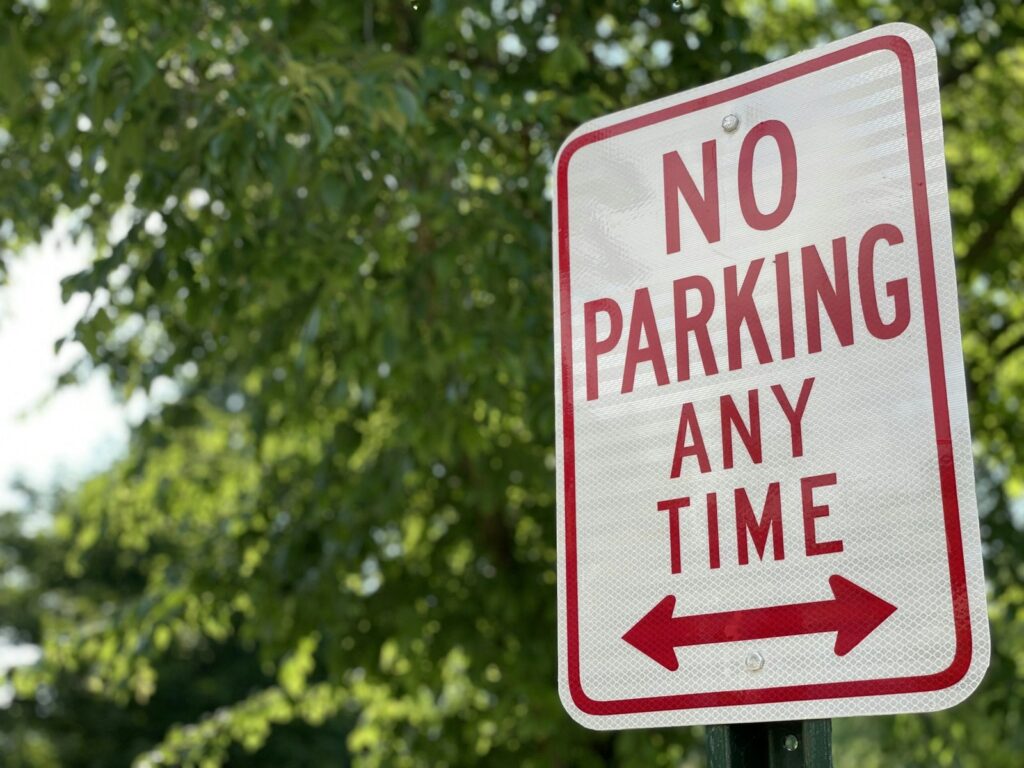
Most street sweeping tickets are not about a sign anyone missed. They are about a sign someone read and got slightly wrong: the wrong week, the wrong side of the street, or a window they thought ended once the sweeper drove past. This guide breaks a sweeping sign into its parts, shows how the “1st and 3rd” pattern really counts, and uses real rules from 17 of the cities we cover so you can see how much they differ.
What every sweeping sign tells you
- Day
- The weekday the restriction applies
- Hours
- The full window; you can be ticketed at any point inside it
- Weeks
- “1st & 3rd” means the 1st and 3rd time that weekday falls in the month
- Months
- A season, odd or even months, or none listed (often year-round)
- Where
- Only your side of the street, between the sign’s arrows
The five parts of a sweeping sign
1. The day
The weekday is the easy part, but read it on the curb where you actually parked. Cities often sweep each side of a street on a different day. In San Francisco, the north side of a block can say “Monday 8 AM to 10 AM” while the south side says “Tuesday 12 PM to 2 PM”. In Long Beach each side has its own day, and in Denver the two sides can differ too.
2. The hours
The window on the sign is the restriction, from the first minute to the last. In most cities it does not end when the sweeper goes by. NYC 311 says so directly for alternate side parking, and Los Angeles, San Diego and Oakland enforce their signs the same way. San Francisco is the main exception: SFMTA’s parking guide says you can park again once the sweeper has passed. Elsewhere, remember that sweepers sometimes make more than one pass, so a clean gutter at 9:15 is not permission to park in a window that runs until 10.
3. The weeks
A sign that just says “Tuesday” usually means every Tuesday. A sign that says “1st & 3rd Tue” or “2nd & 4th Tue” applies only on those Tuesdays. This is the part people get wrong most often, so it has its own section below.
4. The months
Some signs carry a season, such as April to November in Denver or April to December in Cambridge. San Diego uses “Even Month” and “Odd Month” routes, swept only in February, April, June and so on, or in January, March, May and so on. If a sign lists no months at all, assume it applies all year: Boston says that a posted sign without months means a year-round restriction.
5. The arrows and the side
The arrows show the stretch of curb the sign covers. A car parked past the end of the arrow, or around the corner, is outside the posted area, which can be grounds to contest a ticket. And the sign only covers its own side of the street: the curb across from you may have a different day, a different window, or no restriction at all.
How “1st and 3rd” really counts
“1st Wednesday” means the first Wednesday of the month, not “a Wednesday in the first week”. The difference matters whenever a month starts late in the week.
Take a sign that reads “No Parking 8 AM to 10 AM, 1st & 3rd Wednesday” and look at two months in 2027:
| Wednesdays | Count | Move your car? |
|---|---|---|
| January 6, 2027 | 1st Wednesday | Yes, 8 to 10 AM |
| January 13 | 2nd | No |
| January 20 | 3rd | Yes, 8 to 10 AM |
| January 27 | 4th | No |
| March 3, 2027 | 1st Wednesday | Yes |
| March 17 | 3rd | Yes |
| March 31 | 5th | No, not on this sign |
January 1, 2027 is a Friday, so the first calendar week of the year has no Wednesday. Someone counting weeks on a wall calendar would move their car on January 13 and leave it on January 6, the actual sweeping day.
The fifth occurrence is the other trap. In Los Angeles, routes are swept on the 1st and 3rd or the 2nd and 4th weekday, so a 5th Tuesday has no posted sweeping; our Los Angeles guide works through a full month. But a sign that says every Tuesday, like many in Boston, does include the 5th Tuesday. San Francisco has some “1st, 3rd and 5th” schedules too, and its Public Works department publishes a printable calendar that marks which dates are the 1st through 5th of each weekday.
A habit that works: when you see a sign with week numbers, put a repeating event in your phone such as “1st and 3rd Wednesday, move car by 8 AM”, with a reminder the evening before. Phone calendars count weekdays the right way.
Temporary signs come first
A permanent metal sign is not always the whole story. Several cities post temporary signs that override it:
- Chicago: the permanent signs are background. What counts are the orange paper signs the city hangs about two days before a sweep, and the city code lets them declare the block a tow zone (Municipal Code 9-64-040). See our Chicago guide.
- San Jose: during its 2026 towing test, the city put up temporary “No Parking – Tow Away” signs at least 72 hours ahead.
- Seattle: it does not ticket for regular sweeping, but it can post temporary no-parking signs with 24 hours’ notice for cleaning and other work, and those are enforced (city rules).
If your car stays parked on the street for several days, have someone walk past it. Temporary signs go up while you are away. Our guide to temporary no parking signs covers the notice rules city by city.
What the sign doesn’t say about holidays
Very few sweeping signs mention holidays, yet each city handles them differently:
- Skipped: Los Angeles does not enforce on its national holiday list unless the sign says “Holiday Enforcement”. Santa Monica skips 13 city holidays, Long Beach 11.
- Skipped, but not at night: in San Francisco, daytime sweeping is off on SFMTA holidays, but overnight sweeping is still enforced on most of them (SFMTA holiday schedule).
- Moved: in Cambridge, a sweep that falls on a holiday is moved to another date, sometimes in the previous month.
- Next month: Berkeley sweeps monthly and does not make up holiday sweeps, so your street waits until its next scheduled day.
Our Thanksgiving and Christmas 2026 guide lists the end-of-year rules for every city.
No sign on your block
In most cities, no sweeping sign means no sweeping ticket. That is more common than people think:
- In San Diego, roughly nine in ten swept blocks have no sign at all; the city just asks you to move voluntarily.
- San Jose sweeps every residential street monthly but only tickets where a no-parking sign is posted.
- In Washington, DC and Denver, the parking ban applies only on blocks with posted signs.
- Seattle does not ticket for street sweeping at all.
Other parking rules still apply on an unsigned block, of course: colored curbs, hydrants, driveways and time limits. Our fines by city page shows what a sweeping ticket costs where signs are posted.
Missing, faded or confusing signs
When a sign is missing, turned, covered by a branch or contradicted by another sign, that is often the strongest reason to contest a ticket. Washington, DC lists “signs missing or obscured” among its seven legal defenses for parking tickets. Elsewhere, a dated photo of the problem sign is the evidence our city guides recommend first.
Do two things right away:
- Take dated photos: the sign (or the empty pole), the stretch of curb between the arrows, and where your car was.
- Report the sign: in Long Beach, for example, through the Go Long Beach app or (562) 570-3264; in most other cities, through 311.
And if a website, an app and the sign disagree, follow the sign. Denver’s own reminder service says posted restrictions take precedence over what it shows, and that is the safe rule everywhere. Our guide to appealing a street sweeping ticket covers the deadlines in each city.
How signs work city by city
| City | What to look for |
|---|---|
| Los Angeles | Weekday and window, swept 1st & 3rd or 2nd & 4th week |
| San Francisco | Day, hours and weeks per side; night sweeping on busy streets |
| Oakland | Day and hours on the block’s sign; whole window enforced |
| Berkeley | Once a month, such as “2nd Tue”, morning or afternoon slot |
| San Diego | Only posted blocks; some routes in odd or even months |
| San Jose | Only posted streets; temporary tow-away signs in tests |
| Long Beach | Weekly, a different day for each side |
| Santa Monica | Weekly day and window on the “No Parking” sign |
| Chicago | Orange temporary signs, posted about two days ahead |
| New York City | Red sign with a broom symbol (alternate side parking) |
| Hoboken | Days and hours posted on each block |
| Boston | Day and weeks, such as 1st & 3rd Tuesday; no months listed means year-round |
| Cambridge | Monthly per side, April to December; holiday sweeps are moved |
| Philadelphia | Day and two-hour window, only in the 14 program neighborhoods |
| Washington, DC | “No Parking for Street Cleaning” signs, two-hour windows, March to October |
| Denver | Red-and-white signs, once a month per side, April to November |
| Seattle | No sweeping tickets; watch for temporary no-parking signs |
Have a residential permit? It does not cover the sweeping window; see what a residential parking permit exempts.
Ticketed where the sign was missing or unclear? See how to contest a street sweeping ticket with photos.
Once you know your sign, set a reminder: see street sweeping alerts.
Spotted something out of date? Report an error and we will check it against the official source. Missing a city? Request it here.
Last checked against official city sources for each of those 17 cities: November 2026.