
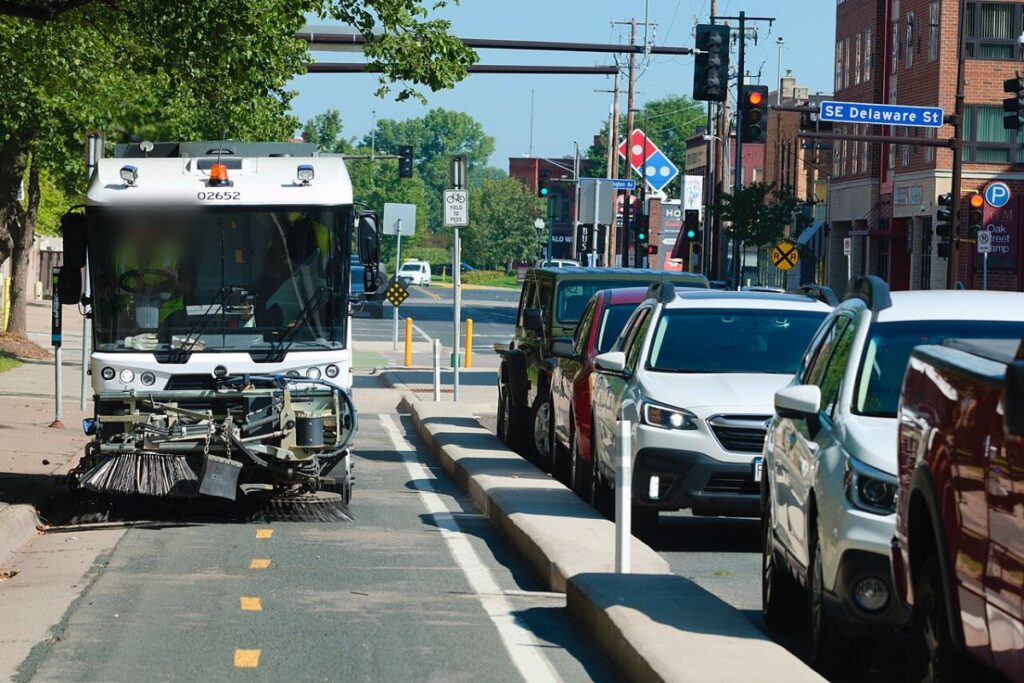
You move your car, the sweeper rolls past for maybe thirty seconds, and the curb looks a little cleaner. It doesn’t feel like much. Add up a whole year, though, and the numbers get big fast. San Francisco’s sweepers and street cleaning crews hauled in 29,413 tons of debris in a single fiscal year. Chicago’s sweepers pick up around 44,000 tons in one April-to-November season. Denver measures its haul by volume: 46,478 cubic yards in 2024, roughly enough to fill 14 Olympic swimming pools.
We went through the official reports and program pages of the cities we cover to find out how much their street sweepers actually collect, what’s in that pile, where it ends up and whether it does any good. Not every city publishes a number, and the ones that do don’t all measure it the same way, so we’ve labeled each figure with its year and its unit.
How many tons each city’s sweepers pick up
These are the cities that publish their sweeping haul by weight. The bar compares each one with Chicago, the largest. Keep in mind that the years differ and that some programs run all year while others stop for the winter, so treat this as a picture of scale rather than a strict ranking.
Chicago IL
44,000 tons
of debris per sweeping season, April to November
San Jose CA
5,000 tons
of oils, metals and debris kept out of the watershed each year
Two big cities are missing from the list. Los Angeles sweeps more than 4,700 curb miles of posted routes, but StreetsLA reports sweeping in miles, not tons. New York’s Department of Sanitation runs about 450 mechanical brooms and doesn’t publish an annual sweeping total either. What it does publish is telling: after the 2024 Thanksgiving Day Parade, crews picked up more than 36 tons of debris along the route, and Times Square produced more than 53 tons after one New Year’s Eve.
Cities that measure by volume
Some cities weigh their haul; others measure how much space it takes up. You can’t convert one to the other reliably, because a cubic yard of wet sand weighs far more than a cubic yard of dry leaves, so we’ve kept these separate.
| City | Collected | Year | For scale |
|---|---|---|---|
| Denver | 46,478 cubic yards of dirt and debris | 2024 | 113,846 lane miles swept. In 2023, the city said its 50,537 cubic yards would fill 15 Olympic-size pools. |
| San Diego | More than 25,000 cubic yards of debris and pollutants | Fiscal 2019 | Over 2,700 miles of streets on 215 routes |
San Diego’s own City Auditor made a point worth repeating: the program was judging itself by miles swept, which says nothing about how much dirt actually came off the street. The audit recommended tracking total debris collected and sending sweepers more often to the routes that produce the most.
Per mile swept: whose streets are dirtiest
Dividing the haul by the distance swept gives a rough sense of how much debris sits on each mile of curb. Only three cities publish both numbers in the same unit:
San Francisco comes out around three times higher, but it’s not a clean comparison. Its tonnage counts the whole street cleaning operation, and the city sweeps dense commercial streets at night, where litter piles up fast. The takeaway is simpler: on a busy urban block, a sweeper can lift a couple of hundred pounds of material per mile, much of it fine grit you’d never notice by looking at the curb.
What’s actually in the hopper
If you picture a sweeper full of soda cups and fast-food bags, you’re only seeing the visible part. Most of what comes off the street is much smaller:
- Dirt, sand and grit. The bulk of the load by weight. Denver reports its haul simply as “dirt and debris,” and Sacramento describes it as dirt, gravel and debris.
- Metal particles and oil. San Jose says one reason it sweeps every street at least once a month is to remove fine metal particles left on the road by vehicles. Brake pads and worn parts shed them constantly.
- Tire wear. Seattle Public Utilities is studying whether sweeping reduces tire-wear pollutants, including 6PPD-quinone, a chemical linked to salmon deaths in urban streams.
- Leaves and other plant matter. Leaves, seeds and flowers from street trees are a major source of phosphorus in runoff, especially during fall leaf drop, according to Minnesota’s stormwater guidance.
- Litter. Cups, wrappers, cigarette butts and the rest. It’s the part you see, but sweepers aren’t built for large items: Long Beach and Sacramento both say their machines can’t handle big pieces, piles or bulky debris.
Seattle gives a sense of the mix. Of the roughly 2,600 tons its sweepers pick up each year, around 150 tons are classed as pollutants, the fine particles that would otherwise wash straight into creeks, lakes and Puget Sound.
Fall leaves: the biggest load of the year
In tree-heavy cities, autumn dwarfs everything else. Minneapolis Public Works has said a typical fall sweep collects between 4,000 and 9,000 tons of leaves. Sacramento handles leaves separately from sweeping: from November to January, residents pile them in the street and a machine nicknamed “the Claw” scoops them up. The city says about 25,000 tons are collected during leaf season alone, compared with roughly 1,000 tons a year from regular sweeping, according to a city spokesperson quoted by CBS13.
That’s also why fall sweeping schedules slip. Chicago kept posting sweeping signs through December 17 in 2026, nearly a month past its usual cutoff, because leaves were still clogging curbs. Our guide to fall leaves and street sweeping covers what that means for parking.
Where it all goes
Sweepers don’t drive to the dump after every route. They empty into dump trucks or roll-off containers, and the material is sorted from there. The usual path, as Minnesota’s stormwater guidance describes it:
- Screening. The load is sifted to separate trash from sand, soil and organic matter.
- Landfill. Litter and anything that can’t be reused goes to the landfill. Minneapolis uses its spring sweepings, mostly winter sand and grit, as landfill cover.
- Compost. Fall loads that are mostly leaves are composted. Minneapolis pays a contractor to turn its fall leaves into compost, and Sacramento says it collected more than 12,000 tons of leaf-season material for recycling in one season.
- Reuse. Some cities screen their sweepings and reuse the clean sand as fill or winter road sand.
One more resource goes into the job: water. Sweepers spray as they go to keep dust down. Sacramento has said its sweepers use about as much water in a year as an Olympic-size pool holds, across roughly 150,000 curb miles.
Does street sweeping actually work?
For water quality, the strongest evidence comes from Seattle, which started sweeping arterial streets specifically to keep pollutants out of its waterways. Over the program’s first four years, sweeping intercepted one and a half times the pollutants removed by all of Seattle Public Utilities’ other water quality treatment facilities combined, at four to ten times lower cost than typical treatment infrastructure. Since 2016, the city counts 475 tons of pollutants removed from its roads this way.
Cities also sweep for more everyday reasons: debris clogs storm drains and causes local flooding, gritty bike lanes are dangerous, and cleaner streets tend to stay cleaner. Federal stormwater permits under the Clean Water Act are another driver. San Diego, for example, describes sweeping as part of how it meets those obligations.
Why your parked car matters
This is where the numbers come back to the parking sign on your block. A sweeper’s side brooms work along the curb, which is exactly where debris collects. Los Angeles County Public Works puts it plainly: when a sweeper has to weave around parked cars, it misses the dirt between the cars and the curb. Washington DC’s DPW says the same thing: cars on a route can leave parts of a block unswept.
So the rule that annoys everyone has a practical reason. If you’re looking for somewhere to put the car, see where to park on street sweeping day, and if you want a reminder before your next sweep, our guide to street sweeping alerts lists the official options by city.
Planning ahead? The 2027 street sweeping holiday schedule shows which days you can skip, and the fines by city page shows what it costs when you don’t move. For your own city’s rules, start at the city directory.
Official sources
| City | Source |
|---|---|
| San Francisco | Public Works annual performance report, FY2023-24 |
| Chicago | Department of Streets and Sanitation figures, via FOX 32; 2026 extension (Chicago Sun-Times) |
| Long Beach | Public Works: street sweeping |
| Oakland | Street sweeping program debris tonnage |
| San Jose | City of San José; DOT street sweeping |
| Seattle | Office of Sustainability: pollutant removal; WA Ecology: 6PPD-q sweeping study; Water Environment Federation |
| Washington, DC | DPW spring operations; DPW street and alley cleaning |
| Cambridge | Street cleaning program |
| Denver | DOTI street sweeping; 2023 figures (CBS Colorado) |
| San Diego | City Auditor: performance audit of street sweeping |
| Sacramento | Recycling and Solid Waste Division; Sacramento City Express: leaf season; CBS13 |
| Minneapolis | KARE 11; WCCO |
| New York | About DSNY; Thanksgiving parade cleanup |
| Los Angeles | StreetsLA street sweeping; LA County Public Works sweeping tips |
| Minnesota guidance | Disposal options for street sweeping materials; Recommended sweeping practices |
Spotted something out of date? Report an error and we will check it against the official source. Missing a city? Request it here.
Figures from each city’s most recent published report or program page, checked November 23, 2026. Years and units differ between cities and are shown next to each number.